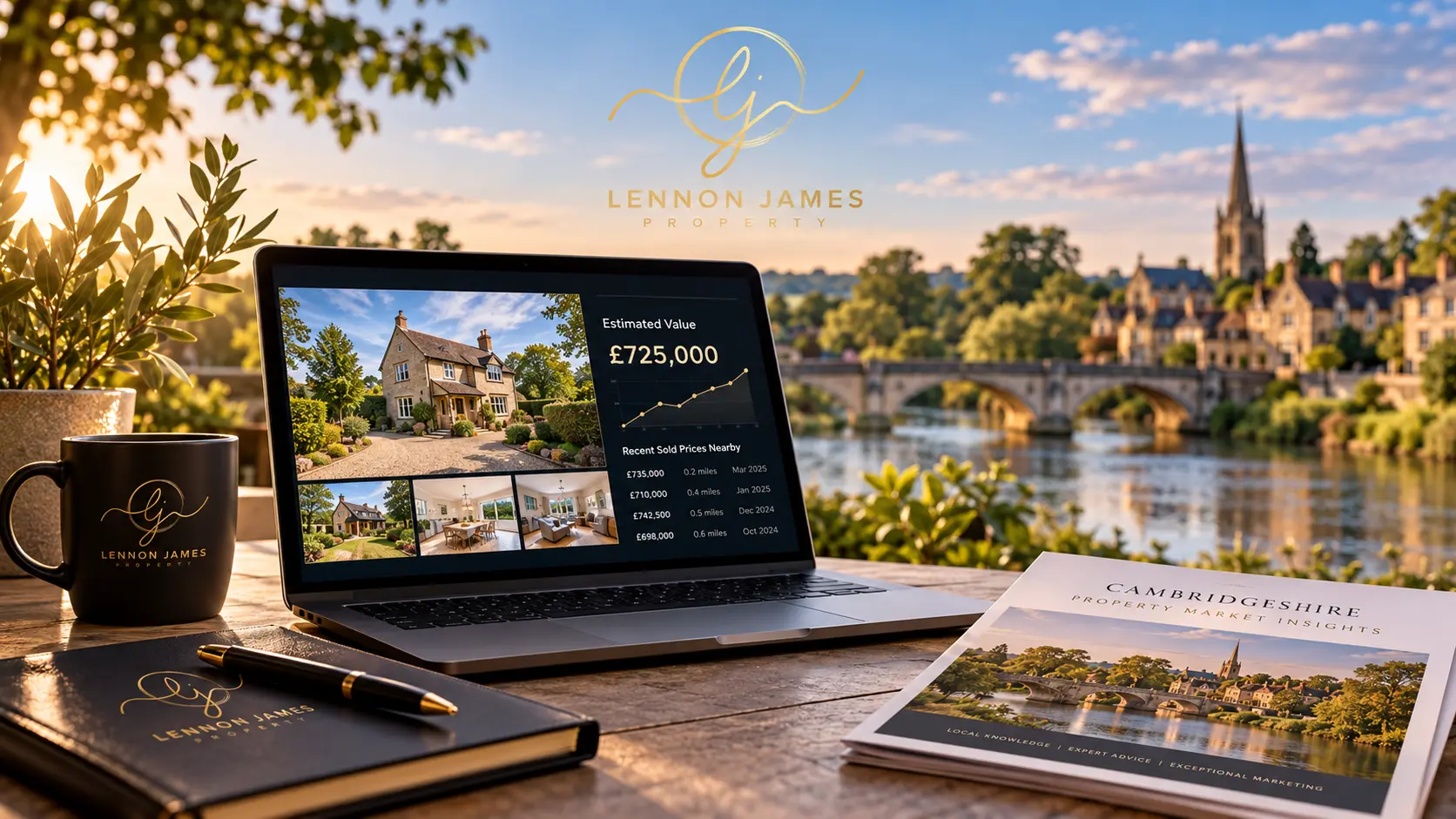
How Much Is My House Worth in Cambridgeshire? | Lennon James
How We Value Property and Why the Highest Estate Agent Valuation Isn't Always the Best One
By Jon Brierley, Founder & Managing Director of Lennon James Property
“How much is my house worth?”
It is probably the question I've been asked more than any other during my career in property.
And understandably so.
For most people, their home is their largest financial asset. A difference of 5% on a £500,000 property is £25,000. On a £750,000 home, it's £37,500.
So getting the valuation right matters.
But after spending the majority of my working life in property, first in estate agency, then more than 12 years at Rightmove working with estate agents and housebuilders across the UK and now running Lennon James Property, I think there's something homeowners need to understand:
Valuing a property isn't about finding the estate agent prepared to give you the biggest number.
It's about understanding what your home is genuinely worth, how buyers are likely to perceive it, how it should be positioned and what strategy gives you the best opportunity to achieve the strongest possible price.
There is a big difference.
And in a competitive property market, getting that distinction wrong can be expensive.
So, How Much Is Your House Actually Worth?
The simplest answer is:
Your home is worth what the market is prepared to pay for it.
That sounds obvious, but it's important.
An estate agent doesn't ultimately determine the value of your property.
Neither does an online valuation tool.
And neither does the homeowner.
The market does.
Our job as estate agents is to use experience, evidence, data and local knowledge to estimate where that market value sits and then develop a strategy designed to maximise it.
When I value a property, I'm therefore not just thinking:
“What have similar houses sold for?”
I'm thinking about the complete picture.
The location.
The road.
The plot.
The condition.
The presentation.
The accommodation.
The school catchment.
The outlook.
Parking.
Extensions.
Improvements.
Competing properties.
Recent sales.
Current asking prices.
Buyer demand.
Mortgage affordability.
The likely buyer demographic.
And crucially:
How are we going to market it?
Because two similar properties can produce very different results depending on how they're positioned and presented to the market.
What Is the Average House Price in Cambridgeshire?
This is where online searches for Cambridgeshire house prices can become misleading.
There isn't really one Cambridgeshire property market.
There are lots of interconnected local markets.
A property in Cambridge behaves differently from one in Huntingdon.
St Ives is different from Ramsey.
The Hemingfords are different from Somersham.
Houghton is different from Alconbury Weald.
Even within the same town, moving a relatively short distance can materially affect value.
Current Land Registry-backed data presented by Rightmove puts the average sold price across Cambridgeshire at approximately £372,000 over the last year, but that countywide figure only tells part of the story.
Property type matters enormously too.
And once you move down to town, village, street and individual, property level, averages become progressively less useful.
That's why I would never value your home simply by applying a percentage to the Cambridgeshire average.
Your property needs to be valued as your property.
Why Do Estate Agents Give Different Valuations?
This is one of the questions homeowners ask me most often.
You invite three estate agents to value your property.
Agent one says:
£475,000.
Agent two says:
£500,000.
Agent three says:
£550,000.
Who do you choose?
The temptation is obvious.
£550,000 sounds considerably better.
But before signing anything, I'd ask one word:
Why?
Why is your home worth £550,000?
What comparable evidence supports that figure?
What has genuinely sold nearby?
What competing homes are currently available?
How long did comparable properties take to sell?
Were their asking prices reduced?
What makes your property better or worse?
Who is the likely buyer?
How will the agent generate enough demand to achieve that price?
A professional estate agent should be able to have that conversation with you.
If the only explanation is:
“I think we should try it and see what happens.”
I'd be cautious.
The Highest Valuation Isn't Necessarily the Best Valuation
I think this is one of the most important things I can say to somebody considering selling their home.
Do not automatically choose the estate agent who gives you the highest valuation.
Government guidance for home sellers makes the same point: sellers are advised not to select an agent purely because they suggest the highest asking price and to ask for evidence supporting the valuation.
Why does that matter?
Because an estate agent is competing for your business.
And unfortunately, there can be a temptation within our industry to tell a homeowner what they want to hear in order to win the instruction.
A flattering valuation can be extremely persuasive.
But an unrealistic valuation isn't a compliment if, six weeks later, you're being advised to reduce the price.
Overvaluing Your Home Can Cost You More Than You Think
A common strategy is:
“Let's start high. We can always come down.”
And yes, technically you can.
But there's one thing you cannot recreate.
Your launch.
The first few weeks of marketing are incredibly important.
Your property is new.
Portal alerts are triggered.
Existing buyers notice it.
Social campaigns launch.
Video content goes live.
Potential buyers see it for the first time.
There is freshness and curiosity.
If the price is significantly ahead of where buyers perceive value, those buyers may simply scroll past.
No viewing.
No offer.
No conversation.
Then several weeks later the price changes.
Perhaps again after that.
And buyers start asking:
“What's wrong with it?”
There may be absolutely nothing wrong with the property.
The problem may simply have been the original positioning.
Price Reductions Change Buyer Psychology
This is why I don't think overvaluation is a harmless experiment.
A home launched correctly might create several interested buyers at roughly the same time.
That creates competition.
Competition strengthens your negotiating position.
An overpriced home can do the opposite.
It can create inactivity.
And once a property has been available for a prolonged period, buyers often become more confident about negotiating downwards.
Instead of:
“We need to move quickly before somebody else buys it.”
the psychology becomes:
“It's been available for months. Let's make a lower offer.”
That's a completely different negotiating environment.
Asking Price and Market Value Are Not the Same Thing
This distinction is really important.
The asking price is part of your marketing strategy.
The market value is what a willing buyer is ultimately prepared to pay.
And your eventual sale price is the result of bringing those things together successfully.
Sometimes the correct strategy might be to launch very close to expected value.
Sometimes there may be justification for testing a slightly higher figure.
In another situation, positioning a property strategically within a popular portal search bracket could increase exposure and competition.
There isn't one formula that works for every home.
That's why valuation should be a conversation rather than somebody walking around your property for 15 minutes and announcing a number.
Rightmove Search Brackets Matter More Than Many Sellers Realise
This is another consideration when setting an asking price.
Buyers don't always search endlessly upwards.
They set budgets.
Imagine a property where the realistic market value sits somewhere around £900,000.
Positioning at £925,000 may sound attractive.
But somebody searching:
£800,000–£900,000
may never see it.
That doesn't automatically mean £895,000 is the correct strategy.
But it demonstrates why pricing isn't simply about choosing the biggest possible number.
Price determines visibility as well as value perception.
This is something we consider carefully when advising Lennon James clients.
What Comparable Properties Have Actually Sold For?
Comparable evidence is an important part of every valuation.
But there's another distinction homeowners should understand.
Asking prices aren't sold prices.
If a similar house is advertised at £650,000, that doesn't mean it's worth £650,000.
It might eventually sell for £625,000.
It might sell for £650,000.
It might sell for more.
Or it might not sell at all.
That's why we look at both:
what is currently competing with you
and
what buyers have actually paid.
HM Land Registry sold price information is particularly useful because it records completed transactions in England and Wales.
But even comparable sales require interpretation.
A property sold nine months ago may have been in better condition.
Or worse.
It may have had a larger plot.
A different outlook.
More parking.
An extension.
A better position within the road.
That's where data ends and professional judgement begins.
Online House Valuation Tools: How Accurate Are They?
Online valuation tools can be useful.
I've spent enough of my career around property technology and data to appreciate what they can do.
They can analyse enormous quantities of information very quickly.
They can identify previous sales.
Property type.
Local price trends.
Comparable transactions.
And they can give homeowners a useful starting point.
But an algorithm hasn't necessarily stood in your kitchen.
It hasn't seen the view from the garden.
It doesn't know how the extension flows.
It may not appreciate the quality of a renovation.
It might not understand that one end of a road commands a premium.
It doesn't necessarily know that the property opposite has just undergone a major improvement.
And critically:
It isn't going to market your house.
So by all means use an online property valuation as an initial indication.
But if you're seriously considering selling, I believe there is still enormous value in having an experienced local estate agent visit the property.
Local Knowledge Matters, But Not in the Way It Used To
I have a slightly different view on this from some traditional agents.
I absolutely believe local property knowledge matters.
But I don't believe local knowledge is defined by whether an estate agent has a shop 500 yards from your house.
We operate from a central marketing office and work across multiple Cambridgeshire property markets.
That was a deliberate commercial decision.
We wanted to invest in people, technology, marketing and distribution rather than creating a chain of traditional High Street branches.
To value property properly in an area, you need to understand:
buyer behaviour,
recent sales,
competing stock,
schools,
transport,
local developments,
roads and villages,
price differentials,
and where buyers are coming from.
That's what local expertise means to us.
How We Value Homes at Lennon James
When I visit somebody's home, my aim isn't to give them the number most likely to make them choose Lennon James.
My job is to give them the advice I would want if it were my property.
Sometimes that means telling somebody I think their home is worth more than they expected.
Sometimes it means agreeing completely with their own expectations.
And occasionally it means having a difficult conversation because I think the figure they have in mind is too ambitious.
I'd rather have that conversation at the beginning.
Because telling somebody their home is worth £50,000 more doesn't make it worth £50,000 more.
The market will ultimately decide.
But Valuation Is Only Half the Conversation
This is where I think Lennon James approaches valuation differently.
After discussing:
“What is the property worth?”
I want to discuss:
“How are we going to make buyers want it?”
Because those two things are connected.
You can have the most accurate valuation in Cambridgeshire, but if the property is poorly photographed, weakly described and passively uploaded to a portal, have you really given it the best opportunity?
I don't think so.
Marketing Can Influence the Result
At Lennon James, we believe marketing is one of the most important controllable factors in achieving the strongest possible outcome.
We cannot change the wider economy.
We cannot control mortgage rates.
We cannot control government policy.
And we cannot manufacture buyers who don't exist.
But we can control:
how your property looks,
how it is positioned,
how many relevant people see it,
and
how compellingly its story is told.
That's why our approach can include professional photography, cinematic video, drone imagery, 360-degree virtual tours, digital brochures, enhanced portal listings and targeted social-media campaigns.
Being on Rightmove Isn't Enough
I spent more than 12 years at Rightmove.
I understand how important the portal is.
It is an extraordinary platform and remains fundamental to modern property marketing.
But almost every estate agent you're considering will put your property on Rightmove.
So the question isn't:
“Will my property be on Rightmove?”
It should be:
“What will make somebody choose my property when they see it on Rightmove?”
And then:
“How are you going to reach buyers who aren't searching for my exact location yet?”
That's where the wider marketing strategy becomes important.
Your Buyer May Not Currently Live in Cambridgeshire
This is something we've seen repeatedly.
The eventual buyer for a Cambridgeshire property may not currently live in the town or village where we're selling.
They may be elsewhere in Cambridgeshire.
London.
Hertfordshire.
Essex.
Bedfordshire.
Or further afield.
That's why our marketing isn't confined to somebody already typing a particular postcode into a property portal.
We use social media to proactively introduce homes and locations to potential buyers.
Our own audience has grown to more than 10,000 followers across Facebook and Instagram, supported by more than 5,000 pieces of published content.
That's important because valuation isn't only about identifying today's obvious buyer.
Good marketing can expand the audience.
We Don't Just Market the House
This is particularly important when attracting buyers from outside the area.
If you're selling in Huntingdon, we're not just selling bedrooms and bathrooms.
We're selling transport connections, schools, amenities and access to Cambridge and London.
In St Ives, we're selling the town centre, river, Guided Busway, schools and lifestyle.
In The Hemingfords, we're selling the village environment and riverside setting.
In Houghton, we're selling the character, countryside and proximity to St Ives and Huntingdon.
In Ramsey, we're selling space, value and the wider Fenland lifestyle.
In Alconbury Weald, we're explaining the community, schools, green space and ongoing development.
Because buyers don't simply buy properties.
They buy locations and lifestyles.
And that can influence what they're prepared to pay.
Professional Photography Isn't About Making a House Look Pretty
It's about creating attention.
Your property could be one of 30 homes appearing in a buyer's search.
The first photograph needs to earn the click.
The next photographs need to keep their interest.
The video needs to create an emotional connection.
The description needs to give context.
The location content needs to answer questions.
The viewing then needs to deliver on the expectation the marketing has created.
Done properly, those things work together.
What Could a Better Sale Price Actually Mean?
This is why I encourage homeowners not to obsess solely over estate agency fees.
Take a £500,000 home.
A difference of just 2% in the eventual result is:
£10,000.
At £750,000:
£15,000.
At £1,000,000:
£20,000.
I'm not suggesting that choosing Lennon James or any other estate agent automatically adds 2% to the value of a property.
That would be impossible to guarantee.
The point is that relatively small differences in the final selling price can outweigh relatively large differences in agency fees.
That's why I believe homeowners should focus on:
The net result.
Not simply the cheapest commission.
What If My Home Is Unusual?
This is where valuation becomes particularly interesting.
Some properties don't have an obvious comparable.
A converted barn.
A substantial village home.
An individual new build.
A waterside property.
A home on an unusually large plot.
A property with significant outbuildings.
A unique architectural home.
In those situations, simply looking at the average price per square foot can be misleading.
You need to understand the likely buyer.
What else will they compare it with?
How far might they travel?
What features create the premium?
And how can the marketing communicate what makes the property special?
The more individual the property, the more important I believe strategy and presentation become.
Should You Improve Your Home Before Having It Valued?
Not necessarily.
I'd actually suggest speaking to us first.
Sometimes homeowners spend significant amounts of money on improvements because they assume those improvements will add more value than they cost.
That isn't always the case.
A £20,000 project doesn't automatically add £20,000 to your selling price.
Sometimes relatively inexpensive changes can make a much bigger difference to presentation:
decluttering,
minor decorating,
gardening,
repairs,
cleaning,
lighting,
or simply preparing rooms properly for photography.
If you're thinking about selling, we're happy to advise before you start spending money.
When Is the Best Time to Get Your House Valued?
Earlier than many people think.
You don't need to be putting your property on Rightmove next week.
A valuation can help you understand:
what your home might be worth,
how much equity you may have,
what your onward budget could be,
whether moving is financially realistic,
what preparation might be worthwhile,
and what selling strategy we'd recommend.
Sometimes the best advice we can give someone is:
“Don't sell yet.”
And I'm comfortable saying that.
A valuation should be advice first and a sales pitch second.
What Should You Ask an Estate Agent During a Valuation?
Don't just ask:
“How much?”
Ask:
Why?
Ask them to show you the evidence.
Ask what has actually sold.
Ask what your competition is.
Ask who they think will buy your home.
Ask where those buyers are likely to come from.
Ask how they will market it.
Ask what happens if the first few weeks don't produce the expected response.
Ask about their photography.
Ask about video.
Ask about social media.
Ask about portal exposure.
Ask about their contract.
And ask how long you're tied in.
At Lennon James, we operate on a rolling agreement rather than asking homeowners to commit to a lengthy minimum tie-in period.
I believe we should retain your business because you're happy with what we're doing — not because you're trapped by a contract.
Beware of Valuation, Fee and Tie-In Working Together
This is a combination I think homeowners should be particularly careful about.
Imagine you're offered:
the highest valuation,
the cheapest fee,
and then asked to sign:
a lengthy sole-agency agreement.
On the surface, it can look like the best proposition.
But ask yourself what happens if the valuation proves unrealistic and the marketing disappoints.
You're now potentially tied to an agent you no longer believe is giving your property the best opportunity.
That's why I'd always consider the complete proposition rather than any individual headline number.
What Is My House Worth in Huntingdon?
There isn't one Huntingdon house price.
A town-centre property can behave differently from a substantial detached home towards the edge of town.
Brampton is different again.
So are the Stukeleys.
Godmanchester has its own market.
And nearby villages can command very different prices.
This is why our Huntingdon Area Guide and local property content sit alongside our valuation service.
The more local context we understand, the better informed the valuation conversation becomes.
What Is My House Worth in St Ives?
The same principle applies in St Ives.
Property type, exact location, parking, proximity to the centre, river setting, school access, condition and plot can all influence value.
And then there are surrounding villages such as Houghton, Hemingford Grey, Hemingford Abbots, Needingworth, Fen Drayton and Somersham — each with its own market characteristics.
A generic Cambridgeshire average cannot capture those differences.
What Is My House Worth in Ramsey?
Ramsey is another good example of why local context matters.
Buyers may be comparing properties not just within Ramsey itself, but with surrounding villages and other parts of Huntingdonshire and Fenland.
For some buyers, the attraction may be the amount of property and land available for their budget compared with areas closer to Cambridge.
That means marketing the value proposition of the location can be just as important as marketing the house.
So, How Much Is Your Cambridgeshire Home Worth?
If you're looking for a number from an article, I can't honestly give you one.
And I wouldn't trust anybody who could.
Your home deserves more than an automated estimate based on a postcode.
The right valuation should consider the property, the location, the evidence, current competition, buyer demand and the strategy needed to take it to market successfully.
That's how we approach valuation at Lennon James.
We don't want to give you the biggest number.
We want to give you the right advice.
And then, if you choose us to sell your home, we want to use everything we've learned from years of property experience, technology, marketing and the Cambridgeshire market to give you the strongest possible opportunity to achieve the best financial outcome.
Because ultimately, the important question isn't simply:
“What will an estate agent value my house at?”
It's:
“What can my home actually achieve?”
And there's a very important difference between the two.
Jon Brierley
Founder & Managing Director
Lennon James Property
Frequently Asked Questions About House Valuations in Cambridgeshire
How much is my house worth in Cambridgeshire?
Your property's value depends on its precise location, type, size, condition, plot, specification, comparable sales, competing properties and current buyer demand. County-wide averages are useful context but cannot provide an accurate valuation for an individual home.
How accurate are online house valuations?
They can provide a useful starting point, particularly where there are plenty of recent comparable transactions. However, they may not fully account for condition, improvements, plot, outlook, exact position and other characteristics visible during an in-person appraisal.
Is an estate agent valuation free?
Many estate agents, including Lennon James Property, provide market appraisals to homeowners considering selling.
Should I choose the estate agent who values my house highest?
Not automatically. Ask the agent to explain the evidence supporting their figure and the marketing strategy they believe will achieve it.
Can an estate agent overvalue my house?
An asking price can be set above the level buyers ultimately accept. An unrealistic launch price may reduce early interest and lead to later price reductions, which is why the evidence behind the recommended price matters.
Does professional marketing increase the value of my house?
Marketing cannot change the underlying property, and no agent can guarantee that particular marketing will increase its value by a set amount. However, strong presentation and distribution can help maximise exposure, buyer interest and competition — all of which can strengthen the conditions in which a property is sold.
How do estate agents value a property?
A professional valuation typically considers recent comparable sales, competing listings, location, property type, size, condition, plot, improvements, current market conditions and buyer demand alongside the agent's professional judgement.
How much does it cost to have my house valued by Lennon James?
Can Lennon James value my home if I'm not ready to sell?
Yes. In fact, speaking to us early can help you understand your likely position and whether any preparation is worthwhile before you eventually launch.
Which areas does Lennon James value properties in?
Lennon James works across Cambridgeshire and the surrounding area, with particular expertise throughout Huntingdonshire and locations including Huntingdon, St Ives, Godmanchester, Brampton, Buckden, Houghton, the Hemingfords, Ramsey, Somersham, Sawtry, Alconbury and their surrounding villages.