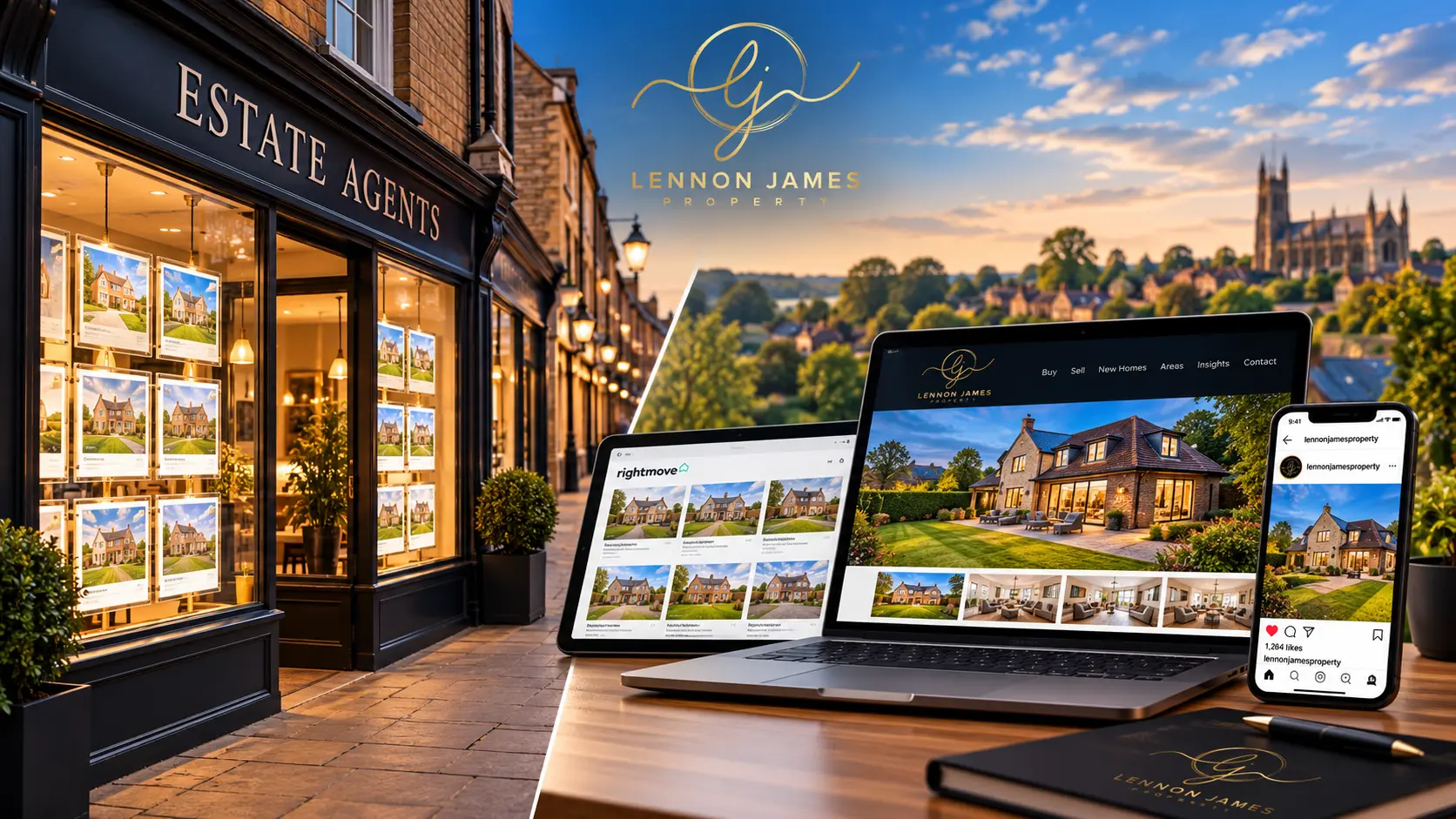
High Street Estate Agent or Modern Marketing? Which Should You Choose?
Or Should You Choose the Agent With the Best Strategy to Sell Your Home?
An opinion piece by Jon Brierley, Founder & Managing Director of Lennon James Property
For generations, choosing an estate agent was largely about geography.
You walked down your local High Street. You saw three or four estate agency offices. You went inside, spoke to the agents, looked at photographs of properties in the window and chose somebody who appeared to know the area.
And there was a very good reason for that.
That was how people found property.
Before Rightmove, Zoopla, smartphones, social media and instant property alerts, an estate agency branch wasn't simply an office. It was one of the main ways buyers discovered what was for sale.
But the world has changed.
So I think homeowners should be asking a different question:
When selling your home today, is the location of your estate agent's office really more important than the location of your buyers?
For me, the answer is no.
And that belief played a significant part in the way we chose to build Lennon James Property.
The High Street Estate Agency Model Made Perfect Sense
I started my career in traditional estate agency, so I understand the High Street model extremely well.
There was a time when an estate agent's shop window was one of its most important marketing tools.
A buyer thinking about moving to Huntingdon might visit Huntingdon High Street.
Someone looking in St Ives would walk into estate agency branches in St Ives.
They would register their requirements, take away printed property details and speak to an agent about what had recently come onto the market.
The physical office connected property with buyer.
Location therefore mattered enormously.
But ask yourself a simple question.
When did you last walk into an estate agency office to find out what homes were for sale?
I'd imagine for many people reading this, the answer is:
A very long time ago.
How Do Buyers Actually Find Homes Today?
Today, somebody can be sitting on their sofa at 10pm and see virtually every property available within their chosen search area.
They can filter by:
Price.
Bedrooms.
Property type.
Location.
Radius.
Schooling.
Features.
They can view professional photography.
Watch property videos.
Explore 360-degree virtual tours.
Study floorplans.
Research sold prices.
Read about an area.
Use Google Maps.
Look at schools.
Explore commute times.
And increasingly, they can discover properties through Facebook, Instagram, YouTube and other digital channels before they have even decided exactly where they want to live.
The evidence of that behavioural shift is difficult to ignore. Rightmove says consumers spent 16.8 billion minutes researching property on its platform during 2025, while more than 80% of all time spent across the major UK property portals was spent on Rightmove. Rightmove Plc
Meanwhile, Ofcom reports that UK adults now spend an average of around four and a half hours online every day, with most of that online time taking place on smartphones. www.ofcom.org.uk
That's the world we're marketing property in.
And I think an estate agency model should reflect it.
Estate Agency Isn't the First Industry to Change
Think about how many other things we used to visit a High Street for.
Holidays
There was a time when booking a holiday meant visiting a travel agent.
You sat at a desk.
Picked up brochures.
Discussed destinations.
The travel agent checked availability and booked it for you.
Today, millions of people research destinations, compare hotels, watch videos, read reviews and book flights from their phone.
Did people stop going on holiday?
Of course not.
The way we bought the holiday changed.
Banking
Going to the bank once meant visiting a branch.
Now we transfer money, pay bills, apply for products and manage accounts through an app.
Insurance
We once visited or telephoned brokers.
Today much of the initial research and comparison happens online.
Retail
Books, clothes, electronics, furniture and even our weekly food shop can now arrive at the front door after a few taps on a screen.
The shop hasn't necessarily disappeared because the product became less important.
Consumer behaviour changed because technology created a more convenient way of finding and buying it.
Property is no different.
That Doesn't Mean Estate Agents Are No Longer Important
Actually, I believe almost the opposite.
Technology has made the quality of the estate agent more important.
Why?
Because putting a property online is easy.
Marketing it exceptionally well isn't.
There is an enormous difference between uploading photographs to Rightmove and creating a strategy designed to maximise attention, enquiries, viewings, competition and ultimately the financial result for the homeowner.
The role of the estate agent has changed.
We shouldn't be gatekeepers to a filing cabinet full of property particulars anymore.
Our job should be to create demand.
Why Lennon James Chose a Central Marketing Office
When we created Lennon James Property, we had a decision to make.
We could follow the traditional model and open individual High Street branches in every town we wanted to work in.
Huntingdon.
St Ives.
Ramsey.
Cambridge.
And potentially keep opening more as the business grew.
Or we could ask ourselves:
Where would that investment make the biggest difference to our clients?
We chose the second option.
Rather than building a network of expensive retail branches, we created a central marketing office from which our team can operate across multiple Cambridgeshire property markets.
That was a deliberate commercial decision.
Not because we wanted to invest less in the business.
Because we wanted to invest differently.
I'd Rather Invest in Marketing Your Home Than Another Shop Window
This is probably the simplest way I can explain our thinking.
A traditional branch network comes with significant overhead.
Rent.
Business rates.
Utilities.
Fit-out.
Signage.
Multiple premises.
And the question I kept coming back to was:
How does another office actually help us achieve a better result for the homeowner?
Sometimes it might.
But increasingly, I believe the money can work much harder elsewhere.
So our investment goes into the things buyers actually see.
Professional photography.
Cinematic property video.
Drone photography and video.
360-degree virtual tours.
Digital brochures.
Enhanced property portal listings.
Technology.
Targeted social-media advertising.
Content creation.
Area marketing.
And ultimately, into getting a client's property in front of as many relevant people as possible.
That is where I believe the modern estate agency battle is won.
A Local Office Doesn't Automatically Create Local Expertise
This is another assumption I think is worth challenging.
Having an office on a particular High Street does not automatically make somebody the best estate agent to sell every property in that town.
And not having an office there doesn't mean an agent cannot understand the market.
Local expertise comes from knowledge, experience, data and actually working within the market.
You need to understand property values.
The competing stock.
Buyer behaviour.
Schools.
Transport.
Villages.
Developments.
Price brackets.
Where buyers are moving from.
What attracts them to an area.
And what makes one property perform differently from another.
That is why we've invested so heavily in understanding and producing content about the individual areas we serve across Cambridgeshire.
We don't just want to know the property.
We want to understand how to sell the location.
Your Buyer Might Not Be Local
This is perhaps the biggest reason I question the traditional obsession with branch location.
Imagine we're selling a property in Ramsey.
The eventual buyer might already live in Ramsey.
But they might live in Huntingdon.
Peterborough.
Cambridge.
London.
Essex.
Hertfordshire.
Or somewhere completely different.
If the perfect buyer currently lives 50 miles away, what difference does it make to them whether their eventual estate agent has a shop 500 yards from the house?
They haven't seen the shop.
They've seen the house.
That's the distinction.
Our job isn't simply to wait for somebody who already lives locally to walk past a window.
Our job is to make the right people discover the property.
That's Why Social Media Became So Important to Lennon James
Rightmove and Zoopla remain hugely important to us.
My own career at Rightmove means I have enormous respect for the role property portals play.
But portals primarily serve existing intent.
A buyer chooses an area, selects a price bracket and searches.
Social media gives us another opportunity.
We can create intent.
We can put a beautiful property in front of somebody who wasn't searching for that particular village yesterday.
We can show them the house.
Then the garden.
Then the countryside.
Then the school.
Then the commute.
Then the lifestyle.
And suddenly:
“I've never considered living there before.”
That is an incredibly powerful part of modern property marketing.
Ofcom's latest research shows just how embedded these platforms remain in everyday life: 89% of adult UK internet users use at least one social-media platform. www.ofcom.org.uk
That is why Lennon James has spent years building its own audience.
Today we have more than 10,000 followers across Facebook and Instagram and have published over 1,260 pieces of content.
We didn't build that audience because social media looks good in a valuation presentation.
We built it because attention matters when you're selling property.
There Is a Difference Between Posting on Social Media and Marketing on Social Media
This is important.
Almost every estate agent now has Facebook and Instagram.
That doesn't necessarily mean they have a social-media strategy.
Posting:
“NEW INSTRUCTION – 4 bedroom detached house”
to the same group of followers isn't particularly sophisticated.
Our approach is much broader.
We can build campaigns around a property.
Create video.
Target different audiences.
Reach people geographically.
Promote particular lifestyle benefits.
Retarget people who have already engaged.
Test creative content.
Increase exposure to content that performs strongly.
And importantly, reach potential buyers who live outside the property's immediate area.
That's why our centralised model works.
Our marketing isn't restricted by the postcode of our office.
The Smartphone Has Become the New Shop Window
I think this is the fundamental change.
The traditional estate agency shop window hasn't disappeared entirely.
But it has been replaced in importance by thousands of individual screens.
Phones.
Tablets.
Laptops.
Smart TVs.
Social feeds.
Property portals.
Google searches.
Email alerts.
WhatsApp messages.
Rightmove reported that in 2024, 73% of all time spent on its platforms was on its mobile site and apps. Rightmove Plc
Think about what that means.
Your property isn't competing for attention against the three other homes displayed in an estate agent's window.
It's competing against everything else on somebody's screen.
That changes the job enormously.
Your Property Has Seconds to Make Someone Stop
A buyer scrolling through Rightmove might see dozens of properties.
Someone scrolling through Instagram might see hundreds of pieces of content.
Your property has to interrupt that behaviour.
It needs to make somebody:
Stop.
Then:
Look.
Then:
Click.
Then:
Want to know more.
That's why presentation is so important to us.
The photography.
The opening video shot.
The drone footage.
The headline.
The description.
The first image.
The social-media creative.
None of these things are accidental.
They are the modern equivalent of putting the best property in the biggest High Street window.
Except the potential audience is dramatically larger.
The Current Market Makes This Even More Important
When buyers have plenty of choice, simply being available for sale isn't enough.
Rightmove reported earlier this year that the number of homes available for sale had reached its highest level for the time of year in 11 years. Rightmove
That creates competition.
And when there's competition, marketing matters.
A seller shouldn't simply ask:
“Which estate agent has an office closest to my house?”
I'd suggest asking:
“Which estate agent gives my property the best chance of standing out from everything else?”
Those are very different questions.
But Does a Physical Office Still Have Any Value?
Absolutely.
I'm not suggesting High Street estate agencies are obsolete.
That would be far too simplistic.
A well-positioned office can create brand visibility.
Some customers prefer face-to-face interaction.
Some people like knowing they can walk into a branch.
An established office can become part of a community.
And there are excellent traditional estate agents operating from High Streets across Cambridgeshire.
This isn't an argument that High Street = bad and centralised = good.
It's an argument that the existence of a High Street branch should no longer be the primary reason you choose an estate agent.
Judge what sits behind it.
If I Were Selling My Own Home, This Is What I'd Look At
I wouldn't start by asking:
“Where is your office?”
I'd ask:
“Show me how you're going to market my property.”
I'd want to see the photography from their existing listings.
I'd watch their property videos.
I'd look at their social channels.
I'd see whether anybody actually engages with the content.
I'd look at their Rightmove presentation.
I'd ask about targeted advertising.
I'd ask how they reach buyers outside the area.
I'd ask how they market the location.
I'd want to understand their valuation strategy.
I'd ask who conducts the viewings.
I'd ask who negotiates the offers.
I'd ask about sales progression.
And I'd read the contract carefully — particularly any lengthy sole-agency tie-in period.
Because those things have a far greater potential impact on my sale than the address printed at the bottom of the agent's letterhead.
A High Street Office Doesn't Sell Your Home. People and Marketing Do.
That's really the Lennon James view.
We didn't create a central marketing office because we wanted to become less local.
We did it because we wanted to work differently.
It enables us to operate effectively across multiple local markets while concentrating our resources, technology, people and marketing expertise in one place.
Rather than asking how many branches we can open, we'd rather ask:
How many relevant buyers can we reach?
Rather than investing in another shop window, we'd rather invest in making your property impossible to ignore on the screens where today's buyers actually spend their time.
And rather than defining “local” by the location of our desk, we define it by our knowledge of the market we're representing.
The Question Sellers Should Be Asking Has Changed
Twenty or thirty years ago:
“Do you have an office in my town?”
was a completely logical question.
Today, I think the better questions are:
Do you understand my market?
Can you demonstrate that knowledge?
How will you present my home?
Where will buyers see it?
How will you reach buyers who aren't already looking here?
What are you investing in my marketing?
And can you show me the results of the strategy you're proposing?
If the agent with the best answers also happens to have an office on your High Street, fantastic.
If they don't?
I wouldn't let geography make the decision for you.
Because buyers no longer need to walk into an estate agency office to discover your home.
Your estate agent needs to make sure your home reaches them.
And that is exactly why we built Lennon James Property the way we did.
Jon Brierley
Founder & Managing Director
Lennon James Property
FAQs: High Street vs Modern Estate Agents
Do I need to use an estate agent with an office in my town?
No. A physical branch can have benefits, but sellers should also consider local market knowledge, marketing quality, portal exposure, social-media strategy, communication, negotiation and previous results.
Is a local estate agent better?
Local expertise can be extremely valuable, but an office address alone doesn't prove local expertise. Look for evidence that the agent understands property values, buyers, competing homes and the lifestyle of the area.
Do buyers still visit estate agency offices?
Some certainly do, and physical offices continue to provide a useful service. However, modern property discovery is heavily digital. Rightmove alone recorded billions of minutes of consumer property research during 2025. Rightmove Plc
Is Rightmove enough to sell my house?
We don't believe it should be the entire strategy. Rightmove is an exceptionally important property portal, but Lennon James combines portal exposure with professional photography, video, drone, virtual tours, digital brochures, area marketing and targeted social-media campaigns.
Why doesn't Lennon James have branches in every town?
We deliberately chose a central marketing office model rather than creating a network of traditional retail branches. It allows us to operate across multiple Cambridgeshire markets while concentrating investment on the people, technology and marketing used to sell our clients' homes.
How can Lennon James sell my home if its office isn't in my town?
Because our ability to market a property isn't restricted by the postcode of our office. We combine local market knowledge with major property portals, professional media, our established social audience and targeted digital advertising to reach buyers locally and further afield.
Does Lennon James still offer a personal service?
Yes. Technology is how we expand the reach of a property; it isn't a substitute for people. Valuation advice, viewings, feedback, negotiation, communication and sales progression still require experienced people.