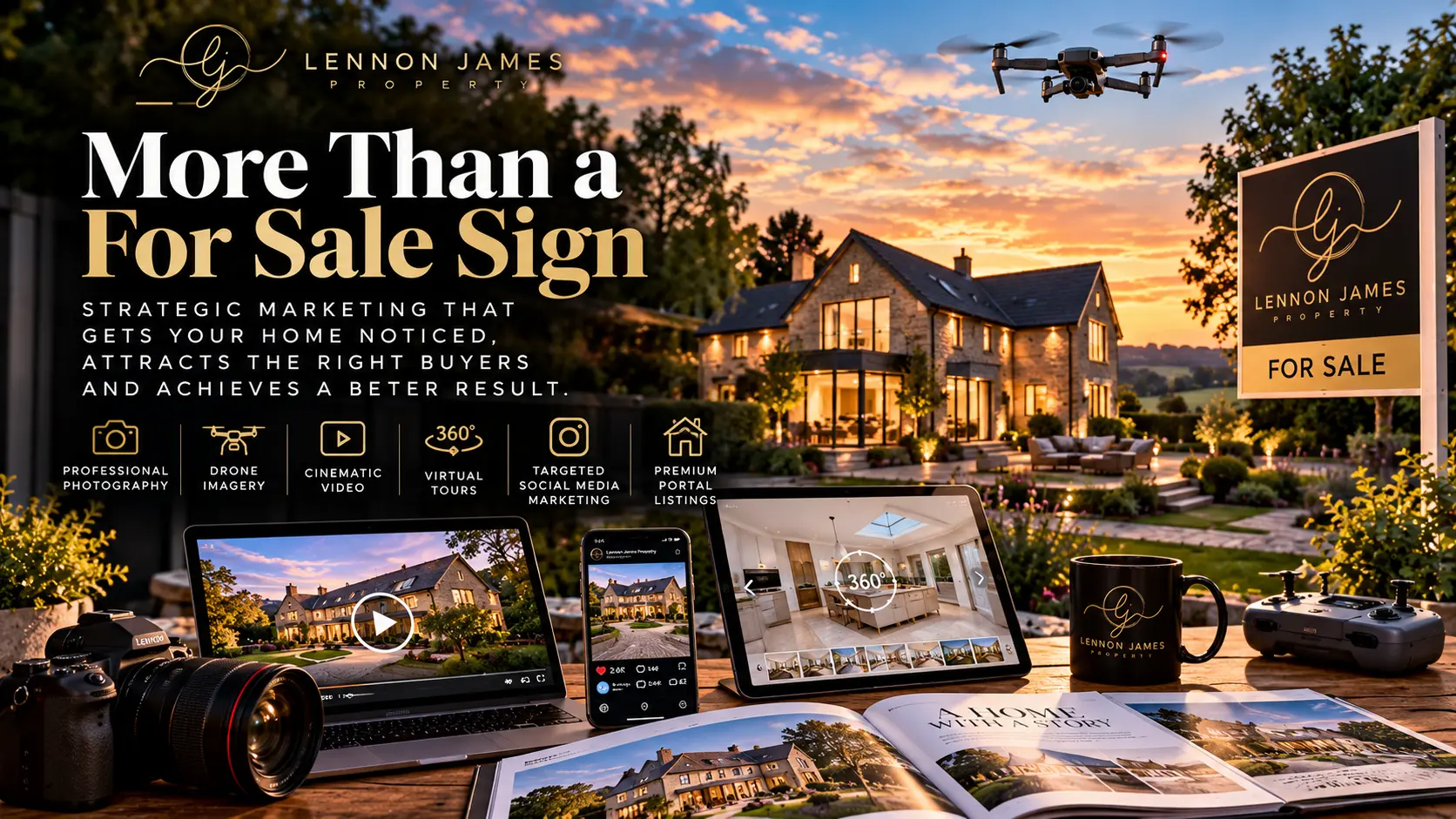
Why Marketing Your Home Properly Could Be Worth Thousands
Why Strategic Property Marketing Matters More Than Ever in Cambridgeshire
If there is one thing I believe most strongly about estate agency, it is this:
The way your home is marketed can directly influence the price you achieve for it.
Not just how quickly it sells.
Not just how many people enquire.
But the final financial outcome.
And in the current Cambridgeshire property market, I think this matters more than ever.
Buyers have choice.
More stock means more competition.
That means every home has to work harder for attention.
The days of simply putting a property on Rightmove, waiting for the phone to ring and calling that a marketing strategy are, in my view, long gone.
At Lennon James Property, we see marketing very differently.
Our job is not simply to list a home.
Our job is to create the strongest possible market around it.
Because the stronger the interest, the stronger the negotiating position.
And that is where the best financial outcomes come from.
Your Home Is Competing Before a Buyer Ever Steps Inside
The first viewing of your property usually doesn't happen at your front door.
It happens on a screen.
A buyer opens Rightmove.
Or Zoopla.
Or Instagram.
Or Facebook.
They see an image.
They decide whether to stop.
Then they decide whether to click.
Then whether to watch.
Then whether to read.
Then whether to enquire.
All of that happens before you even know they exist.
That is why the quality of your marketing matters so much.
If the photography is average, the property can look average.
If the video is weak, the home may not feel exciting.
If the description is generic, the lifestyle can disappear.
If the listing looks like every other house in the search results, a buyer can scroll straight past it.
And once that happens, you may have lost a potential buyer without ever knowing they were there.
The Cost of Getting the Marketing Wrong
This is where people often underestimate the financial impact.
Imagine your property launches at £600,000.
The photography is average.
There is no real social media campaign.
The agent relies almost entirely on property portals.
The launch generates limited interest.
Weeks pass.
The house starts to look stale online.
Then comes the familiar conversation:
“We think we need to reduce the price.”
Now maybe the asking price drops to £575,000.
Then £550,000.
Suddenly the conversation is no longer about maximising your value.
It is about repairing a weak launch.
That can cost tens of thousands of pounds.
And the problem is that you cannot recreate the moment your property first came to market.
Once that first burst of attention has gone, you are fighting to get it back.
Good Marketing Is About Creating Competition
The goal is not simply to generate one buyer.
One buyer gives you one option.
One buyer gives you very limited negotiating strength.
Two or three genuine buyers can change the entire conversation.
If several people want the same home, you have competition.
Competition can protect price.
Competition can strengthen offers.
Competition can reduce negotiating pressure.
Competition can also give sellers greater confidence around their onward move.
That is why I believe marketing sits at the centre of financial outcome.
A great negotiator can only work with the interest they have.
Marketing creates the interest.
The Simple Chain
For me, the logic is straightforward:
Better presentation creates more attention.
More attention creates more enquiries.
More enquiries create more viewings.
More viewings create more opportunities for offers.
More offers create competition.
Competition creates stronger negotiating leverage.
And that gives us the best possible chance of maximising the price.
That is why we invest so heavily in marketing.
Our Two-Pronged Marketing Strategy
At Lennon James, we deliberately use a two-pronged approach.
We want to reach:
1. The buyers who are already searching
And:
2. The buyers who do not yet know they should be searching in your area
Those are two very different groups.
And we believe you need both.
1. Property Portals: Capturing Existing Demand
Rightmove and Zoopla remain hugely important.
They are where active buyers search.
Someone looking for a home in Ramsey, Huntingdon, St Ives or Cambridgeshire will usually begin with a price range, area and property type.
We absolutely want your home to appear there.
But appearing is not enough.
Our aim is for it to stand out.
That means:
Professional photography
Drone imagery
Premium and enhanced listings
Detailed descriptions
Area information
Video
Strong opening images
Carefully structured presentation
The principle is simple.
If your property appears alongside 20 alternatives, we want the buyer to stop at yours.
Why Rightmove Alone Is Not Enough
Rightmove captures active demand extremely well.
But it relies on the buyer already searching.
That is the limitation.
If someone living in Cambridge has never considered Ramsey, they may never search for Ramsey.
If somebody in London is thinking about more space but has not yet explored Huntingdonshire, they may never find your home.
If an empty nester in St Albans would love a large bungalow in Cambridgeshire but has not begun searching here, a portal-only strategy will never reach them.
That is why our second channel matters so much.
2. Social Media: Proactively Finding Buyers
Social media gives us the ability to put properties in front of people.
That is fundamentally different.
Instead of waiting for someone to find the home, we can take the home to them.
Facebook and Instagram still reach huge proportions of UK online adults, which makes them important channels for distribution when used properly. ResearchGate
But there is another distinction.
Posting a property on Facebook is not the same as having a social media strategy.
A real strategy starts with the buyer.
Who are they?
Where do they live?
What are they looking for?
What might make them move?
What lifestyle do they want?
What does your home offer that theirs does not?
Then we build the campaign around those answers.
Targeting Out-of-Area Buyers
This is particularly powerful in Cambridgeshire.
Take Ramsey as an example.
If we simply market a home as:
“Four-bedroom house for sale in Huntingdon.”
we are relying on buyers who already know Huntingdon.
But what if the real opportunity is someone moving out of Cambridge?
Or somebody leaving a more expensive market?
Then the story becomes very different.
We can talk about:
More space for the money
Countryside
Community
Schools
Home office potential
Larger gardens
Broadband
Accessibility
The difference in value compared with more expensive areas
Now the buyer is no longer just comparing houses.
They are comparing lifestyles.
That can completely change the audience.
Our Results Support That Approach
More than half of the homes we have sold over the last year have gone to buyers from outside the immediate area.
That matters.
It tells us that local demand is only part of the picture.
And in campaigns where we have tracked the source properly, social media can account for a smaller proportion of initial enquiries but a much larger proportion of completed buyers.
We have seen campaigns where around 40% of enquiries came via social media, yet social media contributed around 65% of the eventual buyers.
That is why we do not judge channels solely on how many emails they generate.
The quality of the buyer matters more than the quantity of the enquiry.
Why Our Social Media Presence Matters
Lennon James has built an audience of more than 10,000 followers across Facebook and Instagram, with more than 5,000 pieces of content published.
That audience did not appear overnight.
It is the result of years of consistent investment in:
Property content
Video
Local information
Market updates
Area guides
Paid advertising
Photography
Buyer engagement
We believe that level of activity gives us an important advantage when launching a property.
It means we are not starting from zero.
We already have an engaged audience.
And that audience can be combined with paid targeting to expand the reach even further.
Video Marketing
Video is one of the most effective parts of our strategy.
Why?
Because it can communicate far more than static photography alone.
It can show:
How rooms connect
How large the garden feels
How light moves through a home
How the property sits within its plot
What the road looks like
What the surrounding countryside looks like
How the home actually feels
It also gives us a piece of content that can be distributed far beyond the portals.
We can use it on:
Facebook
Instagram
LinkedIn
YouTube
Paid campaigns
Retargeting
That allows us to proactively reach people rather than simply wait for them to search.
360-Degree Virtual Viewings
We also use 360-degree virtual tours because they help qualify interest.
This is especially useful for buyers from outside Cambridgeshire.
If somebody lives 80 or 100 miles away, the ability to understand the property before travelling can be invaluable.
They can explore:
Layout
Room proportions
Flow
Views
Connections between spaces
That usually means the physical viewing is more serious.
The buyer already knows the basics.
They are coming because they are genuinely interested.
That improves the quality of the appointment.
Drone Photography and Video
Drone imagery is not something we use simply because it looks impressive.
It needs to add information.
For the right property, it can show:
Plot size
Countryside setting
Garden layout
Outbuildings
Relationship with neighbouring homes
Proximity to open land
River or water
Village setting
Some homes simply cannot be understood properly from ground level.
If the location or plot is one of the strongest features, it should be visible in the marketing.
Professional Photography
Photography is still the foundation of property marketing.
The opening image is usually the first thing a buyer sees.
And the difference between professional and average photography can be enormous.
Lighting.
Composition.
Angles.
Weather.
Room preparation.
Lens choice.
Timing.
All of those things matter.
You are competing on the same screen against every other property in the buyer's search.
Your home needs to look its best.
Not misleading.
Not artificial.
But genuinely at its best.
Marketing the Location
This is one area where I think estate agency often gets it badly wrong.
Too many property descriptions explain the kitchen in enormous detail and barely mention the place the buyer is actually going to live.
For an out-of-area buyer, location is fundamental.
If we are marketing in Ramsey, we should explain Ramsey.
If we are marketing in St Ives, tell people about the river, Guided Busway, schools and town centre.
If it is Huntingdon, explain the railway station and A1/A14 connectivity.
If it is Houghton, talk about the river, walks and village character.
If it is Alconbury Weald, explain the schools, parks and future development.
People are not just buying a property.
They are buying a life around that property.
That story needs to be part of the campaign.
Digital Brochures
We have also moved heavily towards digital property presentation.
A digital brochure allows everything to sit in one place.
Photography.
Video.
360 tour.
Floorplans.
Description.
Area information.
Features.
The entire presentation can be shared instantly with a buyer.
That matters.
People want information quickly.
And the easier it is to explore a property, the more engaged they can become before the viewing.
Technology Should Have a Purpose
We continue to invest in new technology.
But not simply because it sounds modern.
Every tool has to improve the process.
We use technology to:
Improve presentation
Increase reach
Target audiences
Retarget engaged buyers
Understand performance
Qualify enquiries
Speed up communication
Improve buyer experience
If it does not help sell the home, it is just a gimmick.
Technology should serve the strategy.
Retargeting
Retargeting is another important part of digital marketing.
Imagine somebody watches half of your property video.
Or visits the website.
Or clicks on a social advert.
That person has already shown interest.
Instead of simply hoping they remember the property, digital advertising allows us to re-engage them.
That can help move someone from:
Awareness
to
Interest
to
Enquiry
to
Viewing
That is very different from placing a listing online and waiting.
Lookalike Audiences and Buyer Profiles
We can also build audiences based around people who resemble those already engaging with a campaign.
For example:
A large family home may appeal to households needing more space.
A bungalow may appeal to downsizers.
A rural property may appeal to someone leaving an urban environment.
A modern development may appeal to first-time buyers or commuters.
The creative message can be adapted accordingly.
That is what strategic marketing means.
Different homes need different buyers, so they need different campaigns.
Why This Matters Even More in a Competitive Market
When there are fewer properties available, buyers may have to compromise.
When stock is high, they do not.
They can keep scrolling.
They can compare.
They can wait.
That is exactly why poor presentation becomes dangerous.
If your home does not stand out, there is another one directly underneath it.
And another after that.
So in my view, a market with more competition is precisely the moment to invest more heavily in marketing.
Not less.
What Does Poor Marketing Actually Cost?
Consider a £500,000 home.
If a weak campaign results in a final price 3% below what might otherwise have been achievable, that is:
£15,000.
At 5%:
£25,000.
On a £750,000 home, 5% is:
£37,500.
On a £1 million home:
£50,000.
I am not suggesting professional marketing automatically adds those percentages to a property.
That would be impossible to guarantee.
But it demonstrates the scale of the financial outcome.
A homeowner can spend enormous amounts of time comparing estate agency fees while ignoring the question that matters far more:
Which agent gives me the strongest chance of achieving the best net result?
The Cheapest Agent Is Not Necessarily the Cheapest Decision
Imagine one estate agent charges £4,000.
Another charges £6,000.
The difference is £2,000.
If the second agent generates stronger demand and ultimately achieves £15,000 more for the property, which agent actually cost less?
The answer is obvious.
That is why I do not believe sellers should choose an agent purely on fee.
The important number is not:
What do I pay the agent?
It is:
What am I left with when the sale completes?
The Same Applies to Valuation
The highest valuation is not necessarily the best valuation.
An agent can tell you your house is worth any number they like.
The buyer decides whether they agree.
So when somebody recommends an asking price, ask them:
How are you going to create the demand needed to justify it?
What is the campaign?
What does the marketing look like?
Who will see it?
How will they be reached?
What happens beyond Rightmove?
If the answer is vague, the valuation is just a number.
Why We Believe Lennon James Leads the Way
I think the easiest way to judge an estate agent's marketing is not to listen to what they say.
Look at what they do.
Look at their social media.
Look at the engagement.
Look at the quality of their photography.
Look at the videos.
Look at the properties on Rightmove.
Look at how often they publish.
Look at whether the local area is being sold properly.
Look at whether the brand itself feels current.
Our social following, content output and investment in paid digital campaigns give us a level of visibility that we believe stands apart from much of the local market.
But the important thing is not simply the numbers.
It is what they allow us to do for a seller.
They give us distribution.
They give us an audience.
They give us data.
And they give us the ability to launch a home with far more than a portal listing.
Feedback and Perception Matter
We hear the same thing repeatedly from sellers and buyers.
The marketing looks different.
Properties feel more premium.
The photography feels stronger.
The video creates more emotion.
The brand presentation feels more considered.
That perception is important.
If we are asking a buyer to pay a premium price for a home, the marketing should reinforce that value.
You cannot market a £750,000 property like a commodity and then expect the buyer to perceive it as exceptional.
Presentation shapes perception.
Perception shapes interest.
Interest shapes demand.
And demand shapes price.
Why We Believe Marketing Is the Single Most Important Factor
Obviously, marketing cannot change everything.
It cannot make a poor location excellent.
It cannot make a two-bedroom home into a four-bedroom home.
It cannot make an unrealistic price sensible.
But once the property and price are established, I believe marketing is the single biggest controllable factor in the sales process.
You can control:
How the home is prepared
How it is photographed
How it is described
How it is filmed
How the location is presented
Where it is distributed
Who it is targeted at
How buyers are followed up
How the campaign is refined
Those are the levers available to us.
And if we use them properly, we give the seller the best possible opportunity.
Our Approach at Lennon James
Our strategy is simple in principle:
Capture existing demand.
Create new demand.
We use Rightmove and Zoopla to reach active buyers.
We use social media to reach people beyond that search.
We use photography and video to make them stop.
We use drone imagery and 360 tours to give them more information.
We use area content to sell the lifestyle.
We use targeted advertising to extend the audience.
We use digital brochures to deepen engagement.
And then we track what works and refine it.
That is how we believe property should be marketed today.
Property Is Personal. Marketing Should Be Too.
No two homes are identical.
So I don't believe they should all receive identical marketing.
A £250,000 first-time-buyer home needs one strategy.
A £600,000 family property needs another.
A £1 million country house needs another again.
Different audience.
Different story.
Different creative.
Different targeting.
That is why our approach is built around the individual property rather than a generic package.
My View
I spent more than 12 years at Rightmove.
I have worked with estate agents.
Housebuilders.
Developers.
And homeowners.
And one thing has become increasingly clear to me.
The property industry has become very good at listing homes.
But listing and marketing are not the same thing.
Anybody can upload photographs to a portal.
The real job is to create interest.
To build desire.
To expand the audience.
To find buyers who would otherwise never have seen the property.
And then to turn that demand into the strongest possible outcome for the homeowner.
That is why marketing sits at the centre of everything we do at Lennon James.
Not because it looks good.
Not because it is fashionable.
But because we believe it gives our clients the strongest opportunity to achieve the very best financial result.
Being on the Market Is Not the Same as Being Marketed
If there is one thought I would leave any homeowner with, it is this:
Being on the market and being marketed are not the same thing.
Before choosing an estate agent, ask yourself:
How will my property be presented?
Who will see it?
Where will they see it?
How will buyers outside the area find it?
How will my home stand out from everything else?
What happens if the first campaign does not perform?
And most importantly:
What is this agent doing that gives me the best possible chance of achieving the best price?
At Lennon James Property, that is the question we build our entire service around.
We don't simply want to put your home on the market.
We want to create a market for your home.
Jon
Lennon James Property
Frequently Asked Questions About Property Marketing
Does marketing really affect house prices?
Marketing cannot guarantee a particular sale price, but stronger presentation and distribution can increase the opportunity to generate more qualified interest, which can improve a seller's negotiating position.
Is Rightmove enough to sell a property?
Rightmove is extremely important, but we believe it should be one part of a wider strategy. Portal marketing primarily captures active demand, while paid social-media campaigns can help reach potential buyers who may not yet be searching in the exact area.
Why is professional photography important?
Photography creates the buyer's first impression. In a crowded market, strong images can determine whether someone clicks on a property or scrolls past it.
Does video help sell houses?
Video can communicate flow, scale and lifestyle in a way photography alone cannot, while also creating content that can be distributed through social media.
Why use social media to sell property?
Social media allows an estate agent to proactively put homes in front of relevant audiences rather than relying solely on buyers actively searching through portals.
Does Lennon James use paid social-media advertising?
Yes. Paid targeting forms an important part of our strategy where appropriate, allowing us to reach audiences beyond our existing organic following.
Why target buyers outside Cambridgeshire?
Some properties offer significantly more space, lifestyle or value than buyers may find in more expensive areas. Reaching those audiences can widen the potential market considerably.
What is a 360-degree property tour?
It allows buyers to explore a home remotely before booking a physical viewing, which can be particularly valuable for people relocating from outside the area.
Why use drone photography?
Drone imagery can show plot, position, countryside and surrounding environment in ways traditional photography cannot.
What is a digital property brochure?
It is a central digital presentation containing photography, floorplans, video, virtual tours, property information and local-area content that can be shared directly with interested buyers.
What should I ask an estate agent about marketing?
Ask to see real examples of photography, video, portal listings and social-media campaigns. Ask how much of the strategy is paid promotion rather than simply organic posting, and ask how they plan to reach buyers outside the immediate area.
Why choose Lennon James Property?
Our approach is built around exceptional presentation, proactive distribution and strategic digital marketing. We combine portals, professional photography, cinematic video, drone imagery, virtual tours, local-area storytelling and targeted social media to give every property the strongest opportunity to stand out.