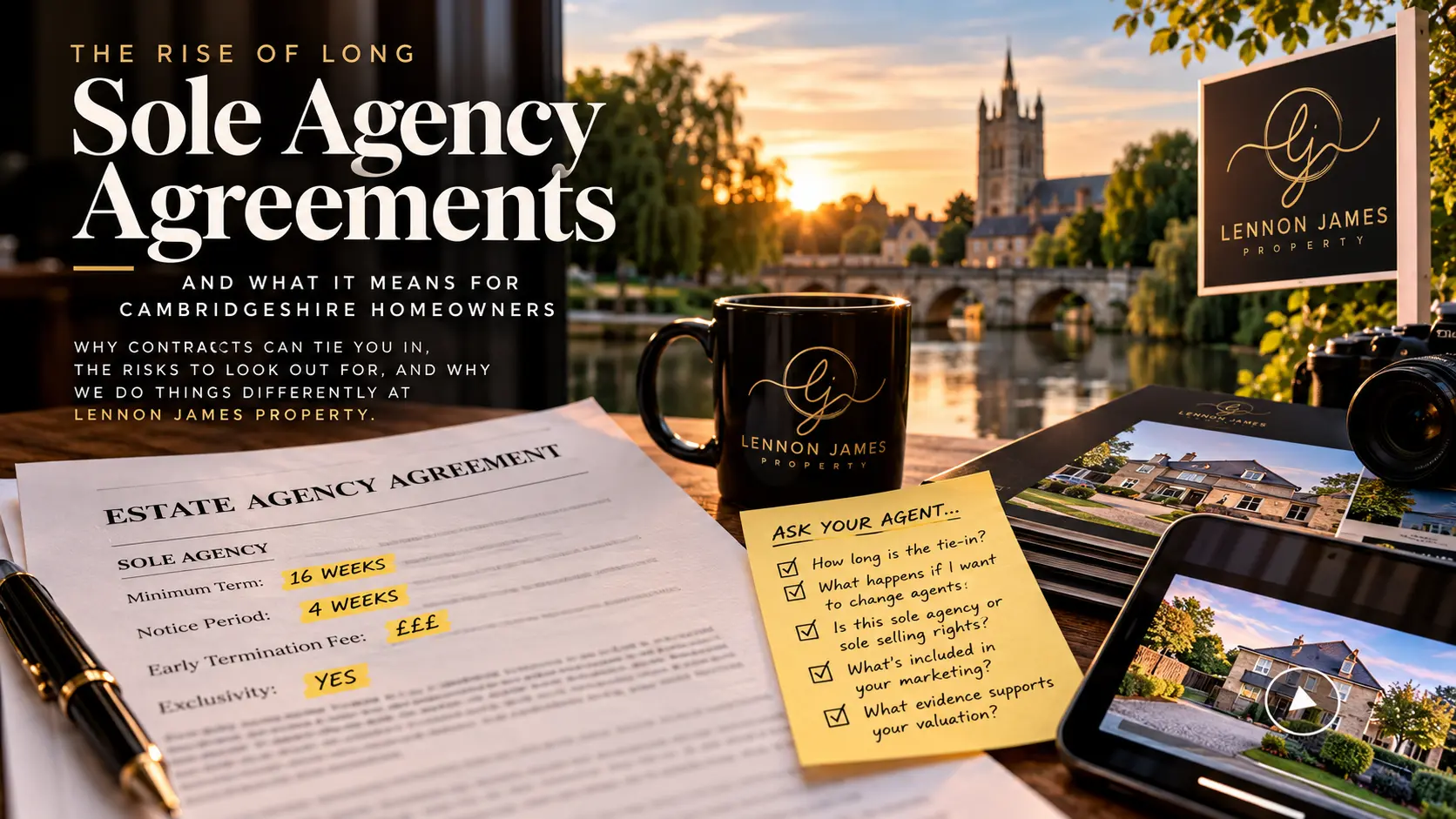
Why Is Your Estate Agent Tying You In?
The Rise of Long Sole Agency Agreements and Why Cambridgeshire Homeowners Should Read the Small Print
There is one question I think every homeowner should ask an estate agent before signing anything:
“If you're confident you're going to do a great job selling my home, why do you need to lock me into a lengthy contract?”
It's a simple question.
But it's one I don't think enough homeowners ask.
I've spent most of my working life in the property industry. I started in estate agency, spent more than 12 years at Rightmove working with estate agents and housebuilders across the country, and eventually created Lennon James Property here in Cambridgeshire.
Over those years I've seen estate agency change enormously.
Technology has changed.
Marketing has changed.
The way buyers search for property has changed.
Yet one thing remains surprisingly common:
Lengthy estate agency tie-in periods.
And personally, I don't like them.
At Lennon James Property, we don't ask our sellers to sign a lengthy minimum tie-in period.
We work on a rolling agreement.
That's deliberate.
Because I believe an estate agent should earn the right to continue representing your home through the service they provide.
Not because a contract prevents you from leaving.
What Is a Sole Agency Agreement?
First, there's an important distinction to make.
I'm not against sole agency.
In fact, most of the properties we sell at Lennon James are marketed on a sole-agency basis.
Sole agency essentially means you appoint one estate agent to take responsibility for selling your property.
That makes sense to me.
One agent is responsible for the:
Valuation and pricing strategy
Photography
Property video
Drone imagery where appropriate
Property portals
Social-media marketing
Viewings
Buyer feedback
Negotiations
Sales progression
There is clarity.
There is responsibility.
And, importantly, there is accountability.
My issue isn't sole agency.
It's the lengthy tie-in period that can come with it.
What Is an Estate Agent Tie-In Period?
A tie-in period is the minimum length of time you agree to remain with an estate agent.
Depending on the contract, there may then be a notice period as well.
That distinction matters enormously.
Imagine signing a contract believing you're committed for 12 weeks.
But the agreement requires an additional four weeks' notice, or says notice cannot be served until the initial period has expired.
Suddenly, what you thought was a three-month commitment can become something quite different.
And estate agency contracts aren't informal agreements.
They are legally binding. Government guidance specifically tells sellers to check what the agent charges, what's included and what the contract says about fees and exclusivity. GOV.UK
That's why the paperwork matters.
Why Do Estate Agents Want Long Tie-In Periods?
Let's look at this fairly.
There are legitimate reasons why an estate agent wants some security when taking on a property.
Marketing a home properly costs money.
There can be considerable upfront investment in:
Professional photography
Video
Drone photography
Floorplans
Property brochures
Premium portal products
Paid social-media advertising
Staff time
Viewings
Marketing preparation
I understand that argument particularly well because we invest very heavily in marketing at Lennon James.
Our approach is deliberately marketing-led.
But here's where my opinion differs.
That's our investment decision.
I don't think the homeowner should have to surrender their freedom for months simply because we've chosen to invest properly in marketing their property.
If we're doing everything we promised to do, why would they want to leave us?
Who Does a Long Sole Agency Agreement Really Protect?
This is the fundamental question.
A long minimum term gives the estate agent certainty.
They know another agent cannot simply take over the property during that period.
It protects their instruction.
But what equivalent protection does the homeowner receive?
Imagine you've instructed an agent.
The photographs aren't particularly good.
The launch is disappointing.
Your property isn't being promoted properly.
Communication starts to disappear.
Viewings aren't being followed up.
Feedback is poor.
Weeks pass.
You lose confidence.
You decide you'd like another agent to take over.
And then you discover:
You can't.
You're tied in.
That's the part I fundamentally disagree with.
What Happens If the Advice Was Wrong in the First Place?
There is another issue that concerns me even more.
The valuation.
Imagine three estate agents visit your Cambridgeshire home.
One recommends:
£500,000
Another says:
£510,000
And the third says:
£575,000
Which valuation is the most attractive?
Probably £575,000.
But which is the most accurate?
That's a completely different question.
An estate agent's valuation presentation is also a sales pitch.
They want your instruction.
That doesn't mean an agent recommending the highest price is deliberately misleading you. Property valuation isn't an exact science and different professionals can legitimately reach different conclusions.
But sellers should recognise the potential incentive.
An optimistic valuation can help win an instruction.
Now combine that with a lengthy tie-in agreement.
The agent wins the property at £575,000.
You sign.
The property launches.
Very little happens.
A few weeks later:
“We think we need to adjust the price.”
£550,000.
Then £525,000.
Eventually perhaps somewhere close to where the other agents suggested in the first place.
But you're still tied to the original agent.
That's where I think homeowners need to be particularly careful.
Overvaluing a Home Isn't Harmless
There's a misconception that there is nothing to lose by starting high.
“We can always reduce it later.”
Technically, that's true.
Strategically, I don't believe it's always sensible.
The launch of a property is incredibly important.
When a home first reaches Rightmove, Zoopla and social media, it has something incredibly valuable:
It's new.
Buyers receive alerts.
People notice it.
Our social-media campaigns begin.
Video launches.
Existing applicants are contacted.
The strongest initial interest should be generated.
If the asking price is substantially disconnected from buyer expectations, that opportunity can be wasted.
Then the property is reduced.
But buyers have already seen it.
It isn't new anymore.
And instead of asking:
“When can we view it?”
they can start asking:
“Why hasn't it sold?”
Government home-selling guidance itself advises sellers struggling for interest to examine price, condition and marketing, and says asking prices should be considered against comparable properties. It also explicitly suggests reconsidering whether another agent could provide a better marketing package. GOV.UK
The problem with a long tie-in is that the second option may not immediately be available to you.
The Combination I Really Dislike
For me, the biggest danger is therefore not the contract alone.
It's this combination:
An ambitious valuation used to win the instruction.
A long minimum agency period.
Poor initial buyer response.
Price reductions.
A homeowner who has lost confidence but cannot easily change strategy.
That's a very uncomfortable position for somebody selling what is probably their biggest financial asset.
Why Lennon James Doesn't Use a Long Tie-In Period
At Lennon James Property, we've deliberately chosen a different approach.
There is no lengthy minimum tie-in period.
We work on a rolling contract.
And I like what that does to our business.
It keeps us accountable.
Every week.
Every viewing.
Every conversation.
Every marketing decision.
Every piece of feedback.
Every negotiation.
If we stop delivering what we promised, I don't think a homeowner should need paragraph 17 of a contract explained to them before they can do something about it.
We should have to keep earning their instruction.
We Put Our Money Into Marketing, Not Into Locking People In
This is probably the biggest difference in our philosophy.
We make a substantial investment in presenting and marketing the properties we represent.
Depending on the individual home, that can include:
Professional property photography
Cinematic property video
Drone photography
Drone video
360-degree virtual tours
Professionally designed digital brochures
Rightmove
Zoopla
Enhanced property listings
Social-media campaigns
Paid targeted advertising
Facebook
Instagram
Video distribution
We've built an audience of more than 10,000 followers across Facebook and Instagram and produced more than 5,000 pieces of content.
We don't believe putting a house onto Rightmove constitutes a complete marketing strategy.
Rightmove is incredibly important.
I spent more than 12 years of my career there.
But property portals capture people who are already actively searching.
Great marketing should reach beyond them.
Our job is to make somebody stop scrolling.
To notice the property.
To watch the video.
To share it with their partner.
To imagine themselves living there.
And ultimately to book a viewing.
We choose to invest heavily in making that happen.
And we still don't believe we need to lock somebody into a lengthy contract to protect that investment.
Why?
Because that's our risk.
Not yours.
We made the commercial decision to build Lennon James around exceptional presentation.
We made the decision to invest in photography.
Video.
Drone.
Social media.
Targeted advertising.
Premium marketing.
I don't believe we should then say to a homeowner:
“Because we've invested in your marketing, you're now stuck with us for months whether you're happy or not.”
Our protection should come from doing a good enough job that you don't want to leave.
“But Doesn't a Rolling Contract Mean Sellers Can Leave Too Quickly?”
Yes.
That's one of the legitimate arguments against our approach.
A homeowner could theoretically become impatient.
A property might have been marketed properly.
The price may be sensible.
The agent may be communicating well.
But the right buyer simply hasn't appeared yet.
Some homes naturally take longer to sell.
A unique £1 million property has a smaller potential audience than a £250,000 first-time-buyer home.
Markets change.
Mortgage rates move.
Buyer confidence changes.
School holidays happen.
Christmas happens.
Selling a property sometimes requires patience.
So yes, from an estate agent's perspective, a minimum term offers commercial certainty.
I understand why agents use them.
I just don't believe our certainty should come at the expense of our client's freedom.
What Should Cambridgeshire Homeowners Ask Before Signing an Estate Agency Contract?
Whether you're selling in Huntingdon, St Ives, Cambridge, Godmanchester, Brampton, Buckden, Houghton, the Hemingfords, Somersham, Ramsey, Sawtry, Alconbury, Needingworth or anywhere else across Cambridgeshire, don't sign an estate agency agreement without asking these questions.
1. How Long Is the Minimum Tie-In Period?
Ask for an exact answer.
Not:
“It's our standard contract.”
Ask:
“What is the earliest date on which I can leave you without penalty?”
That's the number that matters.
2. Is There a Notice Period as Well?
A minimum period and notice period aren't necessarily the same thing.
Ask whether notice can be served during the minimum term or only afterwards.
Understand exactly when the agreement can end.
3. Is This Sole Agency or Sole Selling Rights?
This is incredibly important.
They sound similar.
They aren't.
Under sole selling rights, you may still owe the agent commission even if you find the eventual buyer yourself. Government guidance specifically warns sellers about this distinction and about circumstances in which more than one fee might become payable. GOV.UK
The Property Ombudsman's Code also requires participating agents to take particular care when defining the two arrangements. The Property Ombudsman
4. What Happens If I Find My Own Buyer?
Ask before signing.
Then check that the written contract matches the answer.
5. What Happens If I Want to Change Estate Agents?
Ask:
“Could I ever become liable for two agency fees?”
There can be circumstances where an original agent later claims a fee because they introduced the eventual buyer.
Understand that before moving agents.
6. What Does Your Marketing Actually Include?
This is one of my favourites.
Don't settle for:
“Rightmove, Zoopla and social media.”
Ask what that actually means.
Who takes the photographs?
Is video included?
Is drone included?
Do you create vertical video for social media?
Do you pay to target potential buyers?
What premium portal products are included?
How many people follow your social accounts?
How frequently do you publish property content?
Where will my home actually be seen?
Ask to see examples.
7. What Will I Have to Pay If I Leave?
This is critical.
Photography?
Video?
Drone?
Marketing costs?
Administration charges?
Withdrawal fees?
Advertising?
Find out before you sign.
Consumer terms are subject to fairness requirements. The Consumer Rights Act says an unfair term is not binding where, contrary to good faith, it creates a significant imbalance in the parties' rights and obligations to the consumer's detriment. Legislation.gov.uk CMA guidance also specifically says minimum tie-in provisions can require scrutiny depending on how they operate and the overall contractual balance. GOV.UK
That doesn't mean every tie-in is unfair. It means the terms matter.
8. Why Have You Valued My Home at This Price?
This may be the most important question of all.
Ask to see:
Comparable evidence.
What has sold?
When?
For how much?
How similar was it?
What competing properties are currently available?
What makes yours worth more or less?
Don't choose your estate agent simply because they give you the biggest number.
Choose the agent who can explain their number.
What Should Buyers in Cambridgeshire Know?
This conversation isn't only relevant to sellers.
It affects buyers too.
Imagine a property launches substantially overpriced.
Buyers reject it.
Weeks pass.
The asking price drops.
Then it drops again.
Eventually it reaches a level where buyers become interested.
But something has changed.
The property now has a history.
Buyers have watched it sit online.
They may have seen the reductions.
And psychologically the conversation can shift from:
“How do we secure this house?”
to:
“How much further will they come down?”
That isn't necessarily good for anybody.
The seller may become frustrated.
The buyer becomes suspicious.
And negotiations become anchored around how long the property has been available rather than simply what the home is worth.
Buyers Shouldn't Automatically Assume a Long-Marketed Property Has a Problem
This is important too.
If you're buying in Cambridgeshire and you see a property that has been available for several months, don't automatically assume something is wrong with the house.
There could be many explanations.
It may originally have been overpriced.
The seller's circumstances may have changed.
A previous buyer may have withdrawn.
The marketing may have been poor.
The photography may not have represented the property properly.
The home may simply appeal to a smaller buyer pool.
Time on market is information. It isn't a diagnosis.
Look at the property itself.
Look at comparable evidence.
Then make your own judgement.
Why Good Advice Matters More Than Winning the Instruction
This is ultimately where I stand.
I don't think the purpose of a valuation appointment is to win a listing.
The purpose is to advise a homeowner.
Sometimes those two things align perfectly.
Sometimes they don't.
There have been occasions where I've told a homeowner something I know they probably didn't want to hear.
I'd still rather do that.
Because if I believe a property is worth £600,000, I'm not going to tell somebody it's worth £675,000 simply because I think that will make them sign my contract.
That might win the instruction.
It doesn't necessarily sell the house.
And there's a huge difference between the two.
The Pros and Cons of Long Sole Agency Agreements
I understand the argument in favour.
A minimum period gives an agent enough time to execute a marketing strategy.
It protects upfront investment.
It can discourage homeowners from changing agents impulsively.
It creates continuity.
And a longer marketing period isn't automatically evidence of poor performance.
Those are legitimate points.
But there is another side.
A lengthy agreement can reduce a homeowner's flexibility.
It can make changing strategy more difficult.
It can potentially leave a seller working with an agent they've lost confidence in.
And when combined with an overambitious initial valuation, it can leave the homeowner feeling particularly trapped.
That's why, at Lennon James, we've made a different choice.
Our Contract Shouldn't Be the Reason You Stay With Us
This is probably the simplest explanation of our position.
I don't want a client to stay with Lennon James because they have to.
I want them to stay because:
The photographs are exceptional.
The video makes their home stand out.
Their property is being seen.
We're communicating.
We're following buyers up.
We're giving meaningful feedback.
We're providing honest advice.
We're negotiating properly.
We're progressing the sale.
And they trust us.
That's a much stronger relationship than a 16-week clause in a contract.
Property Is Personal
Lennon James was built around a very simple idea.
Property is personal.
Our name is personal to us.
Your property is personal to you.
And selling your home is too important for the relationship with your estate agent to be based on how difficult it is to leave them.
It should be based on trust.
Marketing.
Communication.
Advice.
Accountability.
And ultimately results.
That's why Lennon James Property doesn't ask homeowners to sign a lengthy minimum tie-in agreement.
We operate on a rolling basis.
We invest heavily in marketing.
And then we accept the responsibility that comes with that.
We have to keep earning your business.
Personally, I wouldn't want it any other way.
Jon
Lennon James Property